
Federal Release Paths From Custody
Federal custody depends on the legal authority, not the place where a person was arrested or temporarily held. A sentenced federal prisoner is usually traced through BOP. A pretrial federal defendant may remain under USMS authority in a contract state or local bed and may not produce a normal sentenced-BOP history. A Bienville Parish Jail departure to a federal receiving agency is a transfer, not a release to the community.
For a sentenced person, a past BOP release date with no facility and a location or status of Released or Not in BOP Custody supports the end of BOP confinement. Read that result narrowly. The person may be on federal supervised release or held by another sovereign.
Check a Federal Inmate Release
BOP supports number and name searches. A register number gives the strongest match when known. Name results can be refined with age, race, and sex, but identity must still be checked against the federal case.
- Open the official BOP Inmate Locator.
- Search by BOP register, DCDC, FBI, or INS number when available.
- Otherwise use the full recorded name and available refinements.
- Match the register number and identity fields to the federal case.
- Read the release date and location or custody status together.
- For pretrial custody, use the federal court and USMS path.
A past date paired with no facility and Released or Not in BOP Custody is the key BOP combination. A future date is projected. IN TRANSIT is not release, and UNKNOWN means the term has not been determined.
Federal BOP Locator Contact
The public BOP locator is nationwide. No local BOP institution or Bienville-specific federal release office was verified. Use the result's institution or the federal court record to identify the right operational contact. For a physical-custody question involving a pretrial defendant, contact the holding facility or USMS through its official prisoner-location route.
The federal district court docket supplies detention and release orders. The agency or facility record supplies the physical departure. As in a Bienville case, one order can coexist with another hold.
Federal Released Record Fields
The locator result includes fields that help prove identity and interpret status. Do not isolate the date from the location. The same date field can represent a completed release when in the past or a projection when in the future.
| BOP field | How to read it |
|---|---|
| Name and register number | Match the correct federal record. |
| Age, race, and sex | Help separate namesakes. |
| Release date | Past or future meaning depends on status. |
| Location | A facility means custody continues there. |
| Released / Not in BOP Custody | Supports the end of BOP custody. |
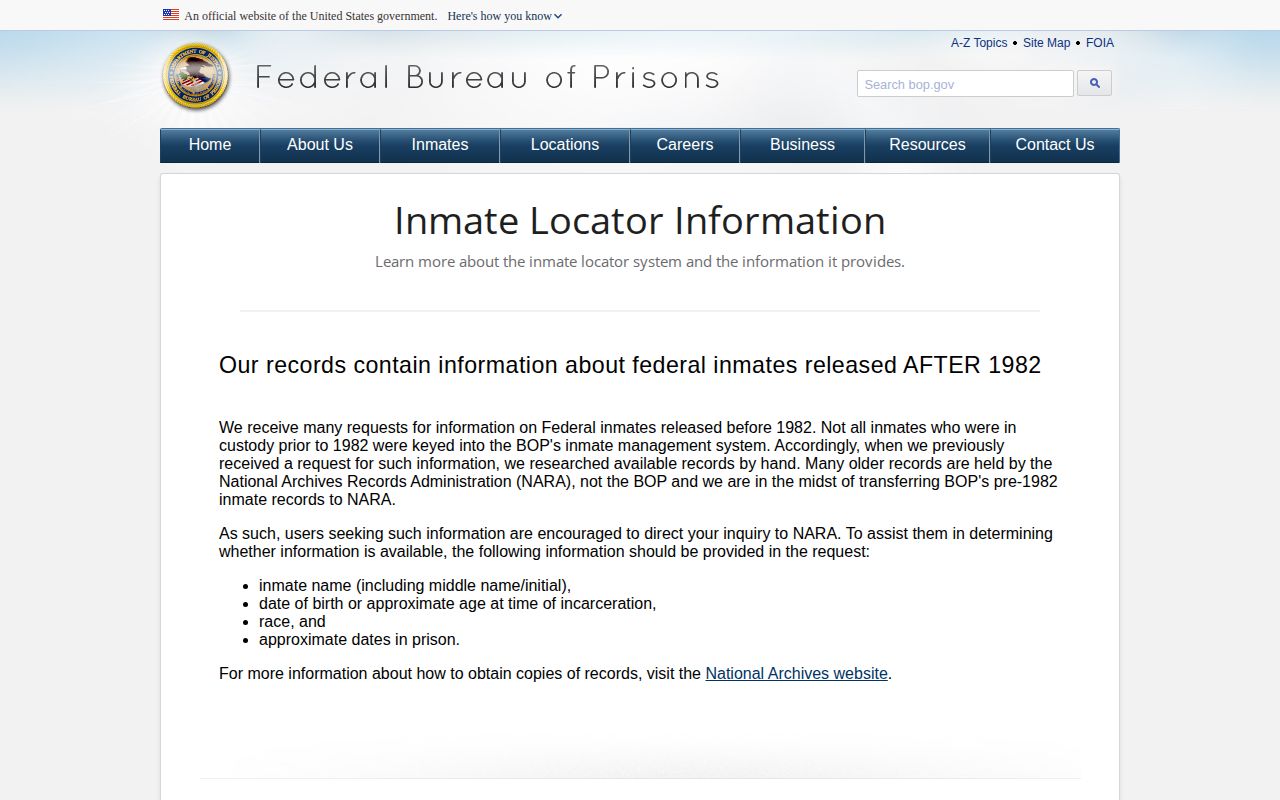
BOP records generally cover people released after 1982. For earlier custody, BOP directs researchers to the National Archives and recommends supplying name, date of birth or approximate age, race, and approximate prison dates.
Federal Pretrial Release Evidence
USMS often controls federal pretrial detention and can use contract beds. A person may be held in a non-federal facility without a standard BOP sentenced-prison record. Search the federal court docket for the detention or release order, then ask USMS or the holding facility to confirm actual physical custody.
A court order is necessary evidence but may not be the gate-out time. Processing, transport, or another detainer can affect departure. Ask the last facility for the date, time, receiving authority, and whether the person entered the community.
Federal and Bienville Transfers
If Bienville Parish Jail records name a federal receiving authority, begin with the sheriff's transfer entry. That record establishes when local custody ended and who accepted the person. Then use the federal docket or USMS path. Do not describe the local out-time as release unless the record says the person returned to the community.
Conversely, a BOP release can lead to a state or local custodian. The BOP result does not clear a Bienville warrant or another case. The Bienville Parish released inmate search provides the local sheriff and Second Judicial District Court checks needed to reconcile those systems.
Federal Supervised Release Status
Supervised release is a federal court-imposed period following confinement. It is not the same as BOP custody, and BOP's released status does not mean every legal condition ended. The federal judgment and docket identify the term, while the supervising federal probation office handles current administration.
Keep the vocabulary clear. Parole is rare in the modern federal system and differs from supervised release. A BOP past release date documents the prison component. The judgment and later court entries document supervision, revocation, or discharge.
A locator user should therefore write down two answers, not one: the date BOP custody ended and whether the federal docket shows a later supervision term. If a revocation occurs, the court record explains the new authority and BOP may later show another custody episode. Do not merge those episodes simply because they share one register number.
Read Past Federal Release Dates
BOP's own record explanation is the best source for the meaning of its date and status. The page states that a past date with no listed facility means release occurred on that date, while warning that another custody or supervision status can remain.
Review the official BOP explanation beside a locator result.
The source supports a precise statement about BOP custody without turning it into a claim about every other agency.
For older records outside the online period, the archival route is not optional. For current pretrial questions, the court and USMS route is stronger. Matching the source to the custody phase prevents a false negative.
Names and dates must be tied to the register number. BOP results can include people with similar names, and the result's age reflects the current display rather than age at admission. Compare the federal case number, judgment, and identity data before treating the release date as belonging to the person sought. For a record before 1982, give the National Archives the broad prison period as well as identity details.
Federal BOP Status Meanings
Several locator labels rule out a completed release. A listed institution means BOP still assigns the person there. IN TRANSIT describes movement within the federal system. A future release date is a projection, and UNKNOWN means the term has not been determined. None should be rewritten as a past release.
The strongest public historical combination is a past date, no facility location, and Released or Not in BOP Custody. Preserve the register number and result date with that status. Then check the federal docket for supervised release and any later revocation. If a state or local receiving agency appears, continue there instead of treating the BOP endpoint as the end of all custody.
Federal number searches reduce namesake risk. The BOP register number is preferred, but DCDC, FBI, or INS numbers can also lead to a result. A name-only search should be checked against the judgment or docket before the date is used.
Older Federal Release Records
The online locator generally covers federal prisoners released after 1982. For an earlier episode, BOP directs the search to the National Archives. Supply the full name, date of birth or approximate age, race, and approximate prison dates. Add a known institution, register number, or federal case when available.
Archived prison history and the federal court record answer different parts of the question. The archive can document confinement and release, while the judgment and docket explain the sentence and later court action. A pre-1982 absence from the modern locator is therefore expected and must not be treated as proof that no federal custody occurred.
For a later federal case with a missing BOP result, determine whether the person was ever committed to BOP as a sentenced prisoner. Short federal pretrial detention may remain a USMS and contract-facility matter. The detention order, release order, and last facility record form the evidence chain in that situation. This distinction also prevents a person held briefly outside Bienville Parish from being searched as though a nationwide BOP sentence record must exist.